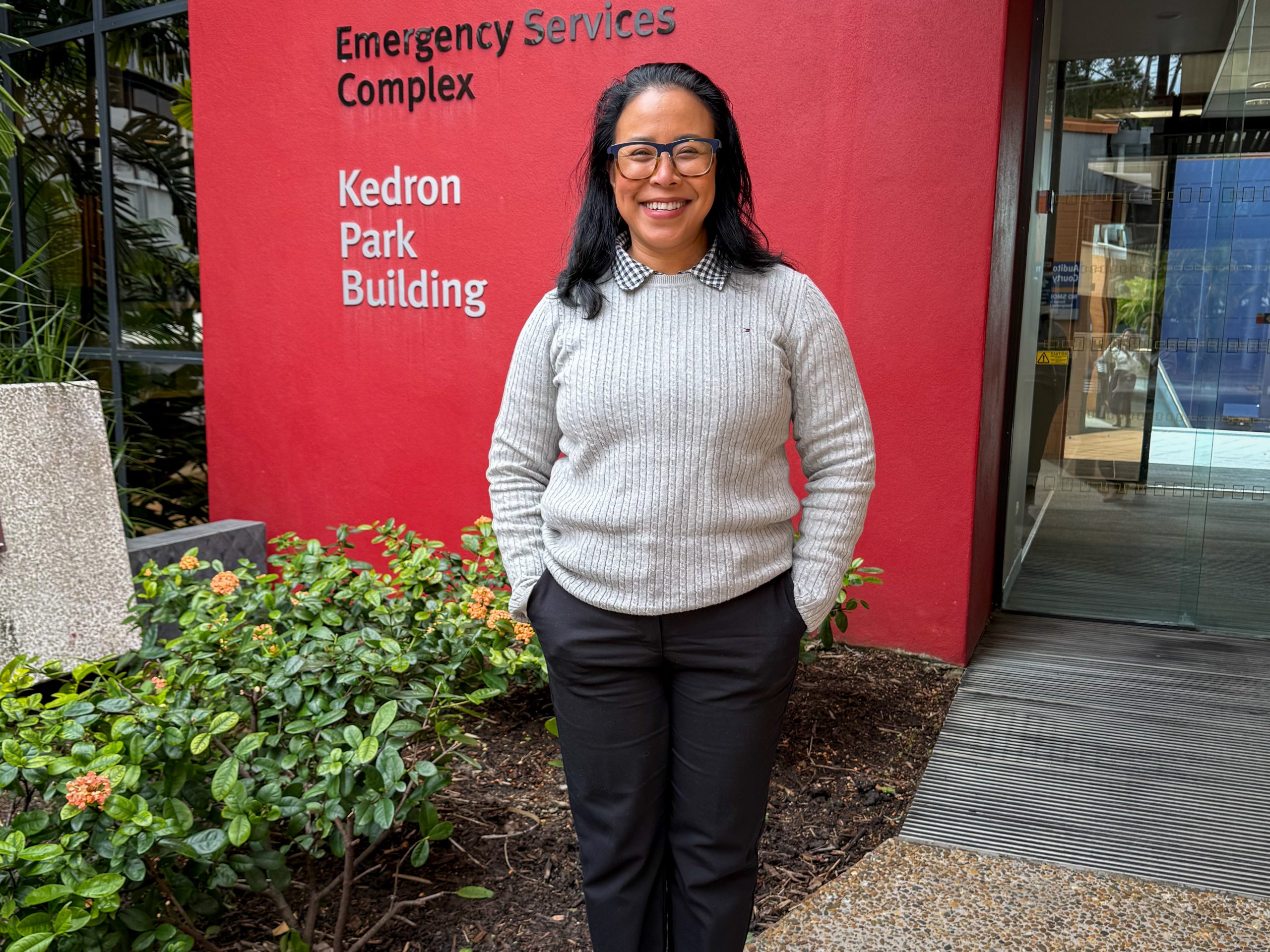
 Fia Hamid-Walker is a doctoral candidate (Disaster Jurisprudence) at the University of Melbourne Law School. She recently took part in Natural Hazards Research Australia’s (NHRA) pilot intern program in association with the Queensland Fire Department (QFD) to tackle Queensland’s complex bushfire legislation.
A lawyer by profession, Fia has spent much of her career with community legal centres, specialising in administrative law, civil law, race discrimination, police accountability and prisoners’ rights. Having grown up in Indonesia, a natural disaster-prone nation where eruptions, earthquakes, tsunamis and cyclones are the norm, Fia is only too aware of humanity’s precarious relationship with our fragile planet.
Opportunity
Today, Fia’s PhD work finds her at the intersection of these two fields as an international disaster scholar. When APR.Intern offered her an research position to investigate the legal framework that governs bushfire hazard mitigation in Queensland, she jumped at the opportunity.
“It wasn’t until I researched the position that I realised it was the first of its kind,” says Fia, highlighting that this was the first time an APR.Intern program had been offered to a University of Melbourne law researcher. “People rarely talk about the role of law and mitigation in the same breath,” she adds. “Because of my background, I felt I had the right skills for this challenge.”
Research
Fia’s research project set out to answer an important question: to what extent do land occupiers in Queensland have a legal duty to manage bushfire hazards on their property? Guided by her extensive legal knowledge and practical experience, she set out to map a clear framework to help the QFD and NHRA better understand the complex regulatory landscape for bushfire mitigation.
“The teams at both the Queensland Fire Department and Natural Hazards Research Australia were really keen to get answers to this question,” she says. “There was confusion over whether private as well as public landholders have a legal responsibility to reduce fuel loads on their properties, and whether the authorities can compel them to do so.”
“You can have the best modelling and scientific knowledge in the world, but if organisations are constrained by law, political will or institutional design – outcomes will fall short.”
Fia Walker, the University of Melbourne Law School.
Landing on an answer, however, wasn’t so straightforward. “There are multiple, overlapping pieces of legislation that landholders must navigate if they want to undertake fuel reduction-related activities,” she says. “The result is that there are few meaningful incentives for private landholders to manage fuel loads, and significant legal and administrative hurdles when they contemplate doing so. Much of this relates to vegetation management and planning laws, which sit equally with the fire legislation.”
 On site
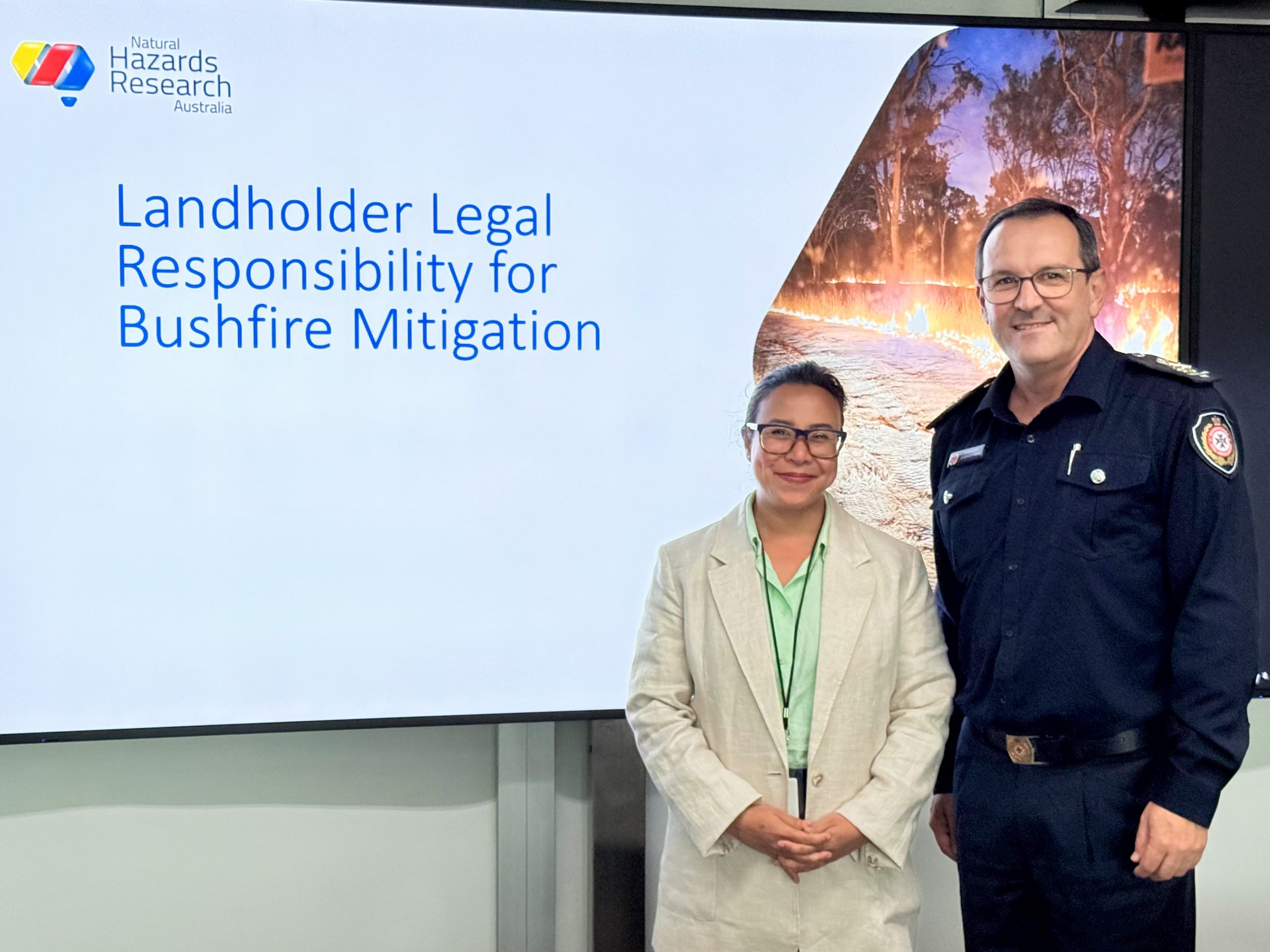
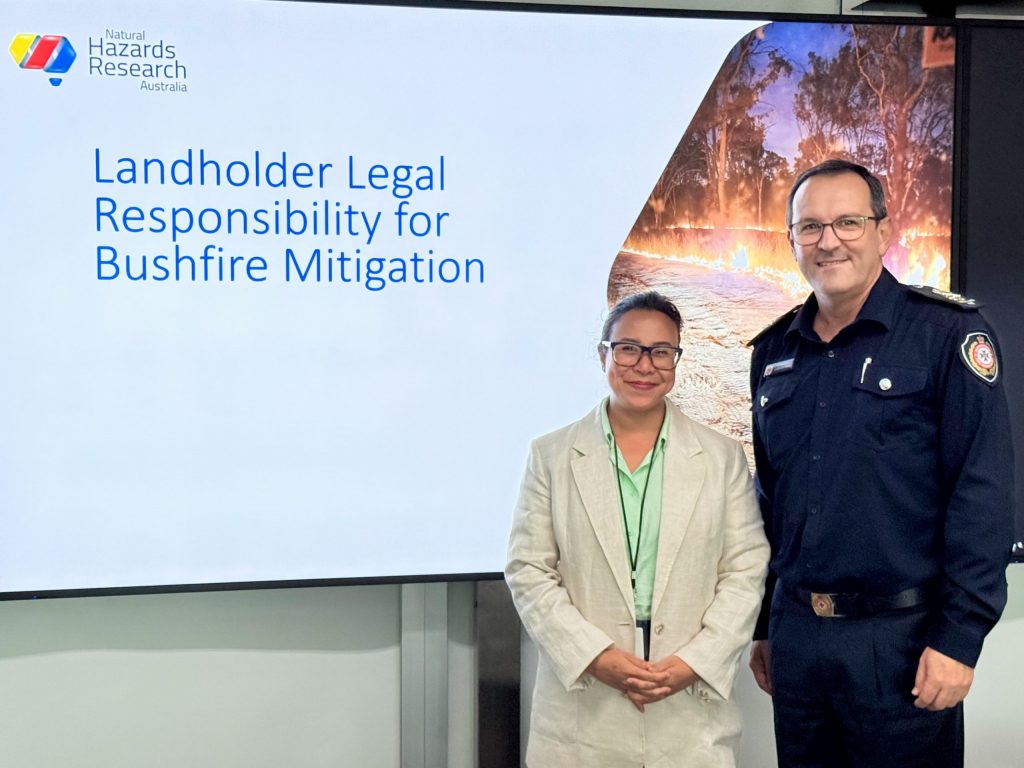
Fia’s APR research was split between desk work in Melbourne and on-site research in Brisbane at the QFD’s headquarters in Kedron, Brisbane. Across three visits over a six-month period, she reported to a principal policy officer within the Legislation Branch of QFD, while also working that branch’s director and wider team. This engagement provided clarity on the operating environment within the QFD and the fire-related statutory limits on what could be achieved for bushfire mitigation related activities.
One element about the QFD which impressed Fia was the sheer scale of the service: “It’s a large, complex organisation; it even has its own team of scientists,” she says. “They have a long history of working with Natural Hazards Research Australia on various scientific projects, which provide a depth of knowledge on bushfire mitigation. This was the first opportunity for a law-based collaboration between the two entities. That’s where my research became useful.”
Findings
Fia’s research has provided a clearer legal understanding of how bushfire mitigation responsibilities are organised in Queensland. Her Final Report deduces that Queensland does not impose a positive general statutory obligation on landholders to proactively reduce bushfire hazards on their land. Under the Fire Services Act (Qld), enforceable duties arise only when an authorised officer issues a requisition notice or an emergency order to a landholder.
Her report concludes that Queensland’s bushfire management regulatory framework is a notice-triggered, multi-legislation model, which differs across tenure type. Responsibility for bushfire mitigation-related activities does not stem from a single ongoing duty but from a combination of statutory triggers, including planning approvals, tenure-based obligations, regulatory notices, and environmental compliance requirements.
Fia believes that these findings will benefit the QFD and/or other states and territories, sparking broader thinking about possible policy changes. “Now that the QFD better understand the legal landscape, it can help inform future policy work relevant to fire management,” she adds.
Career benefits
Fia says her placement will have a long-lasting impact on her career. “My work is about understanding the legal frameworks — the allocation of authority, the limits of law and the practical challenges of implementation.
“It has reinforced the idea that you can have the best modelling and scientific knowledge in the world, but if organisations are constrained by law, political will or institutional design – outcomes will fall short.”
“It’s been a highly valuable experience to have someone of Fia’s skill level on board to undertake what we knew would be a complex piece of research.”
Carly Osborne, Director, Legislation at QFD
Fia notes that her involvement in this tangible in-person internship has brought her own PhD research back to basics, “Grounding theoretical questions in real-world practice is powerful. Few think about how these specific legal questions around disaster governance translate into real-world scenarios. Working closely with practitioners such as the QFD and NHRA has shown me how my research can make a practical contribution, all while enriching the academic work I do in international disaster law.”
Knowledge exchange
Commenting on Fia’s internship, Mark Ovens, Business Development Manager at APR.Intern, highlighted the importance of this internship as the beginning of a mutually beneficial relationship with the University of Melbourne Law School, “While APR.Intern is best known for its STEM placements, our work spans all sectors and disciplines. I suspect that this initial collaboration with the School of Law will be first of many.”
Adding to Fia’s comments, Carly Osborne, Director, Legislation at the Queensland Fire Department said, “It’s been a highly valuable experience to have someone of Fia’s skill level on board to undertake what we knew would be a complex piece of research. The quality of Fia’s research findings has provided us with a report that a range of people will be able to use to better understand the legal complexity of the system that both agencies and landholders work within when it comes to bushfire hazard reduction.
“Bringing Fia into the team and building those relationship between QFD and an NHRA-supported researcher has added additional value to the relationship between the NHRA and QFD, and enabled a knowledge exchange in the form of Fia’s legal academic expertise and QFD’s operational experience in relation to both bushfire and broader disaster response.”
Media Enquiries:
Robbie Byrne
Marketing, Communications and Events Coordinator, APR.Intern
robbie.byrne@amsi.org.au