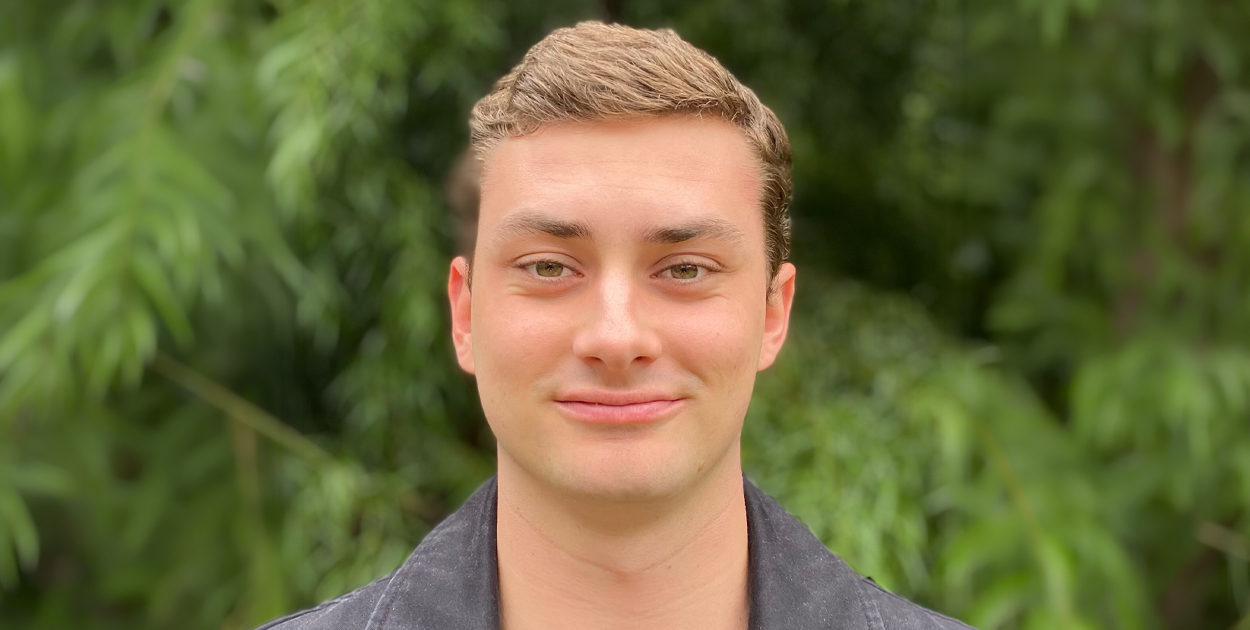
 Stephen Smith is a PhD candidate at the University of Sydney’s (USYD) School of Physics. His research focuses on nanowire networks — a new field of exceptionally efficient computing ‘wires’ capable of learning and remembering on the fly.
Dependent on solar energy, satellites operate under strict energy constraints whilst processing vast amounts of data before transmitting it to Earth. Stephen believes this emerging ‘wire’ technology could provide the computing power needed for next-generation satellites—particularly those designed to detect natural disasters from orbit.
Stephen’s interest in nanowire networks as a technology suited to faster natural disaster detection and response stems from a personal experience. In 2012, a bushfire in the Blue Mountains threatened his home, coming as close as his backyard. “While this research can benefit a whole swathe of natural disasters, there are personal reasons behind my desire to improve bushfire detection,” he says.
Natural disaster detection from space
Stephen aims to develop this technology for satellites that process images of the Earth for natural disaster early warning detections. “These ‘chips’ will do all the onboard image processing,” he says. “With them, we aim to detect natural disasters much faster than what’s currently possible. That will get the relevant data into the hands of first responders quicker than before.”
Having extensively studied nanowire networks through simulations as part of his PhD research at USYD, a placement opportunity at Emergentia facilitated by APR.Intern and funded by the NSW Space Research Network (SRN) provided the perfect gateway to road-test his theories on physical hardware.
“I had a few conversations early on with my supervisor about doing an internship,” Stephen says. “There was a previous student in my research group who completed an internship through APR.Intern and had a great experience; there was a good understanding from USYD on how the experience would benefit my research.”
Real-world testing
Throughout the internship program, Stephen had access to Emergentia’s proprietary technology to test his hypothesis. “They have a chip that’s in the same class of devices as what I’m working on, however, they have the physical hardware to run it. That’s why the placement was so important — to have the opportunity to work with the hardware device rather than just simulating it.”
Founded in 2022 and based in California, Emergentia is a deep tech firm that specialises in constructing hardware neural networks for on-device AI inference and continual learning in robotics, space, and autonomous vehicles. The firm leverages advanced nanotechnology to create electronic devices comprised of millions of nanoelectronic resistive switching elements that are highly interconnected.
“While this research can benefit a whole swathe of natural disasters, there are personal reasons behind my desire to improve bushfire detection.”
Stephen Smith
Thankfully, the transition period from academia to industry wasn’t a difficult one due to Stephen’s research approach, “As my PhD is more application focused, it leans more towards the industry side than a theoretical PhD would. That certainly helped.”
Stephen was also given an opportunity to collaborate on a project with one of Emergentia’s strategic partners, ESA F-Lab, the blue-sky research arm of the European Space Agency (ESA), which is seeking to find better ways to explore space with next-generation intelligent machines.
The placement was a success, but it was not without its challenges. “It would have been nice to have a slightly longer internship,” he says. “In any science, particularly when you have experimental equipment, things go wrong, which they did! There was some time dedicated to problem solving.”
Despite the technical annoyances, Stephen notes that “some great results came out the testing performed.” Numerous tests were completed, which afforded him the opportunity to compare this real-world testing with previous simulations at USYD: “This was another important step toward my research goal.”
USA trip
After presenting his final paper at a conference in Denver, Colorado, Stephen travelled to Los Angeles to meet with Emergentia co founder and associate director of California NanoSystems Institute (CNSI) at UCLA, Adam Stieg — who was also Stephen’s internship co-supervisor. The week-long trip was made possible due to financial support from the Big Questions Institute, a funding platform created to support curiosity-driven research in Australia.
“That’s the kind of collaborative pathway that accelerates breakthrough research.”
Glen Sheldon, APR.Intern National Program Manager
“Adam gave me a tour of the CNSI labs. I met up with some interesting people there. It was great to learn from those who are working in research areas similar to my own at UCLA. I also worked with the research device in person rather than remotely from Australia, which was highly beneficial.”
Rideshare satellite
Stephen’s placement with Emergentia has had a profoundly positive influence on his PhD research. He is confident that findings made during this internship will be included in his thesis and journal publications.
He also has high hopes of further collaboration with Emergentia during the last 18 months of his thesis research: “Depending on funding, we’re hoping to deploy a physical device from this research on board a rideshare satellite,” he says. “That might be done through a collaboration with either Emergentia or USYD. If all goes to plan, that launch would happen at the very end of my PhD in eighteen months’ time.”
Commenting on Stephen’s placement, APR.Intern National Program Manager, Glen Sheldon, said: “What’s particularly exciting about Stephen’s internship is the ecosystem it created. Through APR.Intern and SRN, we connected a promising PhD candidate with a cutting-edge firm like Emergentia, which led to experiences with the European Space Agency and UCLA. That’s the kind of collaborative pathway that accelerates breakthrough research.”
Co founder & Chief Technology Officer of Emergentia, Zdenka Kuncic, commented: “We’re thrilled with the outcomes of the internship project and with what Stephen has achieved in just three short months. The project, aimed at addressing some of the challenges of AI in space, has advanced significantly thanks to Stephen’s contributions and the momentum we’ve gained as a result will help advance an exciting new project with the European Space Agency.”
Emergentia co founder and internship co-supervisor, Adam Stieg, added: “Stephen made a significant contribution to Emergentia during his time with us. His work helped demonstrate the feasibility of deploying our Syntell edge computing technology on highly resource-constrained platforms, providing important validation of both the technology and its potential for efficient edge AI applications. Stephen brought curiosity, initiative, and a willingness to tackle challenging problems, and his contributions helped advance the practical implementation of our technology and demonstrate its broader potential. We’re very grateful to APR.Intern for giving us the opportunity to work with such a talented student.”
Media Enquiries:
Robbie Byrne
Marketing, Communications and Events Coordinator, AMSI
robbie.byrne@amsi.org.au