Anna Durkin is a landscape architect and PhD candidate at RMIT University, Melbourne who took part in Natural Hazards Research Australia’s (the Centre) pilot intern program in 2025.
As devastating wildfires ravaged parts of California in January 2025, Anna found herself conducting her own PhD research into the development of nature-based alternative water treatment landscapes to aid bushfire resilience and alleviate the impact of heatwaves.
Stark warning
For Anna, California’s wildfires were a stark warning for Australia. The fires, which were driven by dry conditions and strong winds, occurred when they were least expected outside the regular fire season in the middle of winter. So, when an opportunity presented itself through APR.Intern to collaborate with the Centre and the Western Australia’s (WA) Department of Fire and Emergency Services (DFES) through the Centre’s internship pilot program, Anna viewed it as a chance to investigate the susceptibility and preparedness of the Perth hinterland for a natural disaster of similar scale.
“I was really interested in the Californian wildfires”, says Anna. “When I look at the planning of land through the lens of a landscape architect, designated fire risk zones often end at the edge of the urban grid — for me, that is concerning.”
Much of Anna’s PhD research involves the use of ArcGIS, a geographic information system mapping tool that enables users to layer data over maps. It’s a skill which she believes was crucial in helping her land the research role with NHRA and DFES
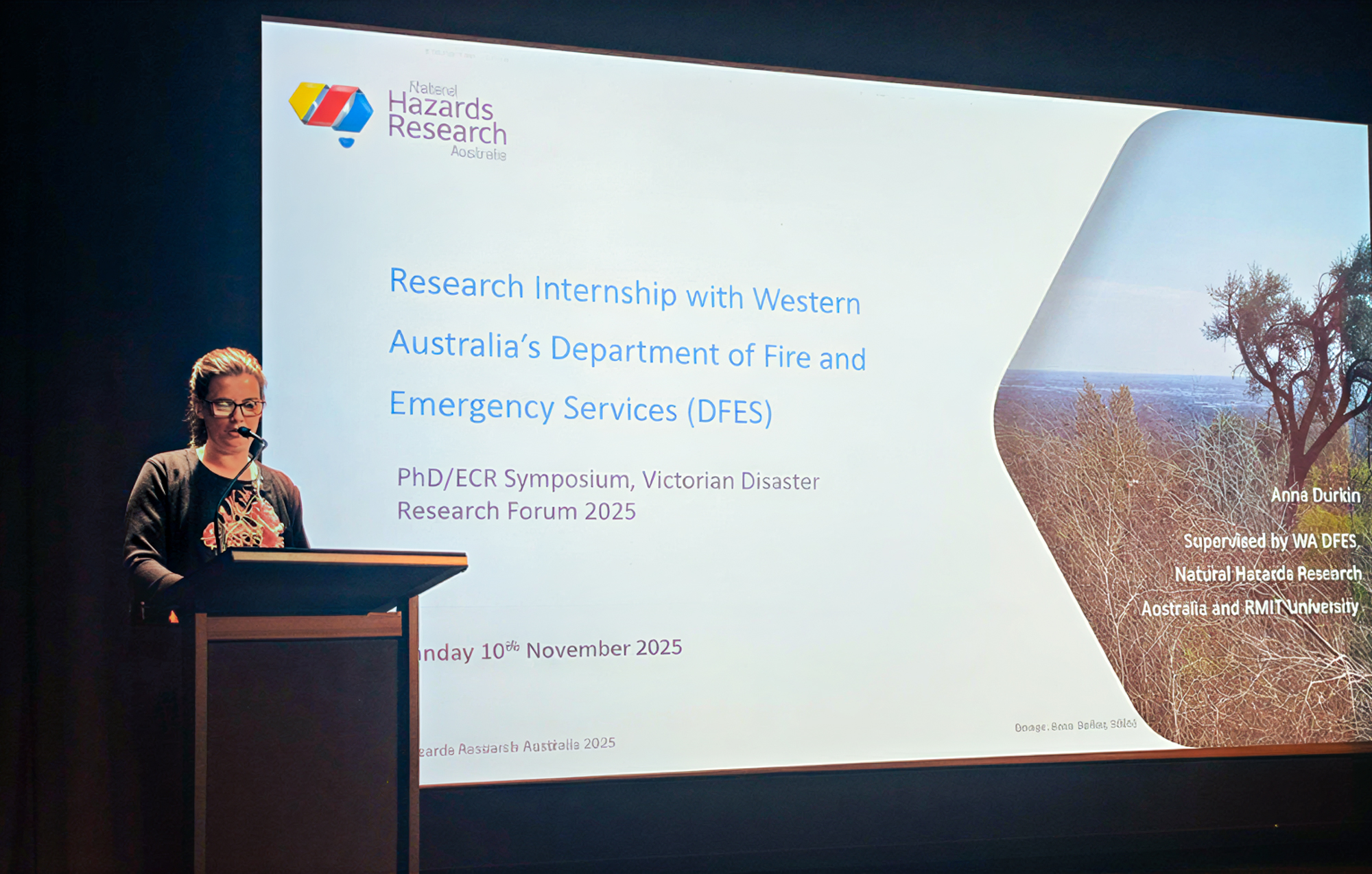
Anna presenting her findings at The 2025 Victorian Disaster Research Forum.
Her Centre-funded internship research project, titled ‘Insights from the L.A. January 2025 fires for Perth, Western Australia’ was conducted over a six-month period from July to December 2025. The investigation focused on fire behaviour, climate, building types, urban design, and fire management processes in preparedness and response in the Perth hinterland.
“I was really interested in the Californian wildfires… When I look at the planning of land through the lens of a landscape architect, designated fire risk zones often end at the edge of the urban grid — for me, that is concerning.”
Anna’s investigation used a comparative case study method. Parameters for comparison included physical factors (climate, topography, prescribed burns and built form) and procedural/management factors (fire zones, pre-deployment, fire management and evacuations). These two parameters were further divided into issues relating to ‘prior to the fire’ and ‘day of ignition.’
Aside from the 2025 Californian wildfires, several other historical fires were reviewed. These included the 2023 Hawaii Lahaina wildfires, Victoria’s 2009 Black Saturday bushfires and previous bushfires in the Perth region. Analysing these events enabled Anna to compare the conditions, preparedness and response of the DFES and related organisations in WA with those faced overseas.
Field research
Anna undertook several trips to Perth while compiling her research, which provided a welcome break from the desk-based lifestyle of her PhD research. “I did four trips”, she said. “The first one was a weeklong trip to attend the Australasian Fire and Emergency Services Authorities Council ‘AFAC25’ Conference & Exhibition. I returned later in the year to present at the Metro Pre-Season Forum 2025 for fire volunteers, where I spoke about what research I had carried out. During that trip, I visited sites in the Perth Hills and worked at the DFES WA headquarters for a week.”
Anna’s research concluded that Perth may be better placed than California in the event of moderate intensity wildland-urban fire(s) due to the prevalence of double brick as a building method for housing and wider practice of prescribed burning. However, several risk factors remain. These include the proximity of the bushland to housing, the mixed building materials of the housing, the age of housing and the location of vulnerable residents, such as those living in retirement villages. Perth also has not faced a fire under the same extreme circumstances as the LA fires, particularly with regard to the speed of the winds combined with the dryness of the landscape.

The Perth Hills
Networking
Anna says that a major benefit of the internship was the networking opportunities it afforded. “It was good for networking”, she says. “My research was based in Perth, so my contacts were largely based in WA — people I may not have otherwise encountered. It was so helpful to link in with the people at the Centre and I still have some connections there. In terms of my own PhD research, it was certainly beneficial to connect with so many people in my field.”
Anna’s industry supervisor, the Director of the Office of the Commissioner of DFES, Matt Watson, also supported Anna to meet and socialise her project and findings.
“It was so helpful to link in with the people at the Centre and I still have some connections there. In terms of my own PhD research, it was certainly beneficial to connect with so many people in my field.”
Having just submitted the first draft of her PhD thesis, Anna is grateful to have had the opportunity to research this important topic as part of the Centre’s pilot internship program. But the work, she suggests, is about more than academic inquiry — it is about rethinking how Australia plans for and lives with the constant threat of bushfires. Her research now sits with DFES as a lessons‑learned and analysis study, helping to reduce the likelihood of a bushfire in WA similar in scale to the 2025 Californian fires.
Commenting on Anna’s internship, Mark Ovens, Business Development Manager at APR.Intern, said that Anna’s work is a prime example of bringing research and practical field research together, adding “Her knowledge of landscape architecture and spatial analysis will allow the DFES and NHRA to look at Perth’s bushfire risk through a fresh, evidence‑based lens, informed by international case studies. The networks and insights developed through this project will not only support Anna’s academic career but also contribute to how fire services in WA assess fire risks in the future.”
Media Enquiries:
Robbie Byrne
Marketing and Communications Coordinator, APR.Intern
robbie.byrne@amsi.org.au